 Chinese
 English
 Russian
The underlying causes of dynamic competition in compound movements
The maximum output power of the entire battery of an electric loader has an upper limit. The total battery output power needs to be allocated to two core loads: the travel drive motor and the hydraulic pump motor. When operating individually, all power is supplied to a single component, providing sufficient power. When performing complex operations, both the travel motor and the hydraulic pump motor simultaneously demand high power, and the total power demand exceeds the instantaneous output upper limit of the battery. The system will then limit the power output, resulting in power contention.
Many modified models adopt a simple fixed power distribution logic. A fixed ratio is set, with a portion of power allocated to travel and another portion to hydraulics. When the excavation condition requires priority for travel traction, the system will not automatically adjust, and the hydraulics will continue to consume power, resulting in insufficient power supply to the travel motor and weak travel performance. If priority is set for travel, when lifting heavy loads, the hydraulic flow will be insufficient, and the boom lifting will slow down. The fixed distribution scheme cannot adapt to dynamically changing load demands, and contradictions are prominent in complex action scenarios.
The dynamic changes in load further exacerbate the problem. At the moment the bucket cuts into the material pile, the digging resistance rises sharply, requiring instantaneous high torque for travel; simultaneously, the boom lifts, and the hydraulic load increases synchronously. Both loads reach their peak simultaneously, and the instantaneous power demand reaches a high point. If the electronic control system cannot identify the priority of the operation actions and allocate power reasonably, there will be power suppression between them.
Some models also adopt a constant output logic for their hydraulic systems, where the hydraulic pump continuously consumes a fixed power. Even during compound actions where full flow is not required for the hydraulic system, it still continuously consumes electrical energy, occupying the power resources of the travel motor. The poor response matching of the superimposed motor and insufficient synchronization of action commands further exacerbate the shortcomings in compound action performance.
Dynamic priority power allocation architecture, allocating power on demand
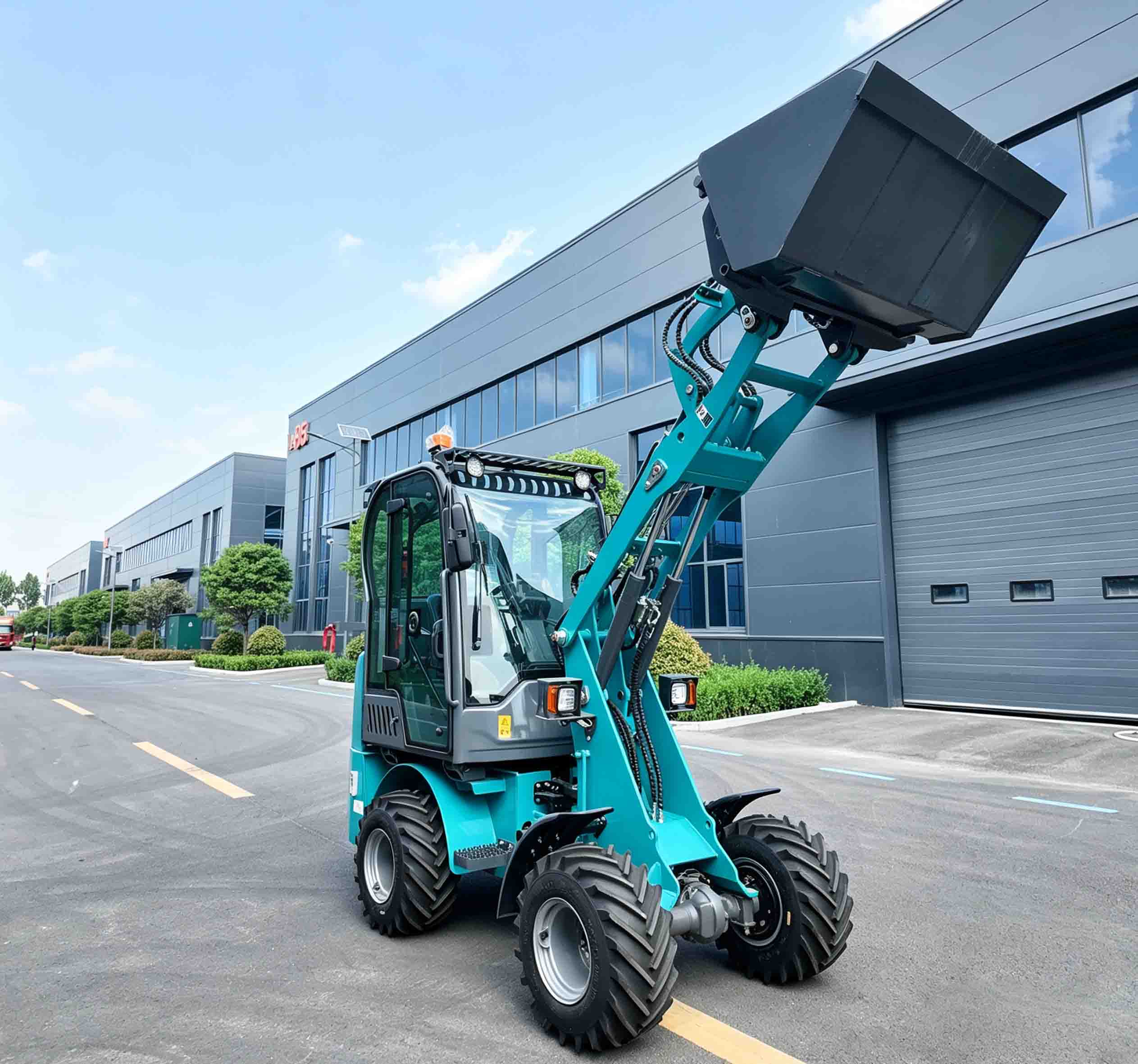
The Jining Xinghang electric loader, with its vehicle VCU serving as the central hub, collects multiple signals in real-time: travel handle commands, hydraulic operation handle signals, travel motor load, hydraulic pump pressure, and available battery output power. The system identifies the current operation intention at the millisecond level, dynamically adjusts the power distribution weights, and prioritizes different operation scenarios.
In the working condition of shoveling and cutting into a material pile, the system recognizes the combined action of advancing, collecting, and lifting, and determines that the priority should be given to ensuring the traction force for travel. At this time, a higher power share is allocated to the travel motor, and the hydraulic system outputs flow as needed, reducing unnecessary hydraulic power consumption to ensure that the bucket can continue to cut into the material pile. When the bucket is full and enters the lifting and unloading phase, the operational objective changes, and the system automatically switches priorities, allocating more power to the hydraulic pump to ensure the lifting speed of the boom, while appropriately reducing the travel power.
When switching to the combined working condition of steering and unloading, the system recognizes the steering and bucket-dropping actions. With a low load demand, it evenly distributes power to maintain smooth operation. The overall power distribution is not a fixed value, but switches priorities in real-time according to the operational actions, achieving "wherever power is needed, it is allocated accordingly". The system sets an upper limit for total power protection to avoid instantaneous battery overload, balancing performance and safety of the three electric systems.
Electro-hydraulic coordination reduces the occupation of ineffective power
Power distribution optimization must be paired with an electro-hydraulic collaborative system to work together. The hydraulic pump adopts an electronically controlled variable displacement pump, which consumes corresponding power only when the required flow is needed. During the composite action process, when the hydraulic system does not require full flow, the pump automatically reduces its output power and releases electric energy to the travel motor, reducing the occupation of ineffective power.
The system predicts the driver's operational intention and analyzes the joystick signal in advance. When the joystick is slightly moved, the system pre-allocates power slightly in advance to avoid sudden power changes at the moment of action initiation. This reduces the jolt caused by power switching and makes compound actions smoother. At the same time, a power smoothing transition algorithm is set up, so that priority switching does not cause sudden power changes, ensuring the operational stability of the entire machine.
Operating condition calibration and actual measurement verification, optimizing composite action experience
Jining Xinghang has completed extensive on-site calibration for various typical material conditions such as sand and gravel, grain, and building materials. Thousands of sets of composite action load data have been collected, and the power distribution strategy parameters have been continuously optimized to distinguish between different scenarios such as soft material light loads and hard material heavy loads. For heavy-load shoveling and digging composite actions, the walking traction force remains stable; for lifting and unloading composite actions, the hydraulic response does not slow down.
Many users encounter walking weakness in compound movements, and their first reaction is to replace the motor with a higher power one. Blindly upgrading the motor requires simultaneous upgrades to the battery and cables, leading to a significant increase in equipment costs and energy consumption. In fact, by optimizing the power distribution logic of the entire vehicle and cooperating with electro-hydraulic coordination, the performance of compound movements can be improved on the basis of existing hardware. The performance ceiling of electric loaders does not solely depend on the power of the hardware; the ability of the vehicle's electronic control system to schedule power resources directly determines the actual performance of compound movements under working conditions.